





Draganfly Innovations Inc. Innovative UAV Aircraft & Aerial Video Systems

UAV Industry News

The latest news about Unmanned Aerial Vehicles (UAVs) and Unmanned Aircraft Systems (UAS). What’s happening in the industry. What’s the latest technology. Who are the leaders.

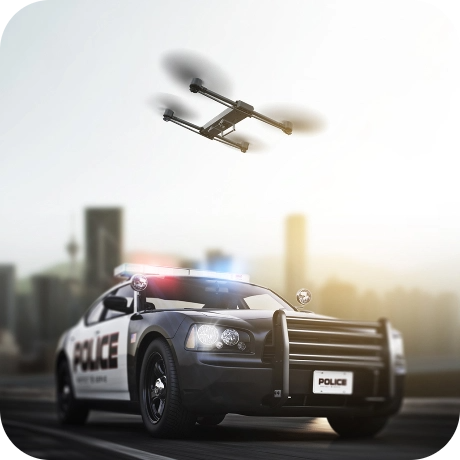
Draganflyer VTOL UAV Helicopter Used in Extreme Cold Temperature for Urban Traffic Police Investigation

Saskatoon Saskatchewan Canada December 23 2009 – Draganfly Innovations operating under the approval of Transport Canada was called to the scene of a traffic accident in order to assist Saskatoon Police in gathering evidence for their investigation.


The weather was extremely cold with winds blowing at 20kmh/12.4mph creating a wind chill of -37°C / -34.6°F . The Draganflyer X6 and held hand transmitter unit performed extremely well in these harsh conditions. The only limitations that were encounter were that of the operators’ hands becoming too cold to fly. In order to remedy this, the operators switched off. While one operator was flying the Draganflyer X6 the other operated sat in a warm vehicle to warm their hands.

The Draganflyer X6 UAV RC Helicopter was used to take aerial photos of the scene of this urban traffic accident. The aerial of photos of this accident will be used by the Saskatoon Police to provide clear evidence for use in their investigation of this traffic accident.

Draganfly Innovations operating under approval of Transport Canada is able to provide assistance to police agencies with Draganflyer UAV helicopters day or night with in a 250 km radius of the city of Saskatoon in rural or urban environments. This 250 km range covers 10 of the 15 cities in Saskatchewan.


The Ontario Provincial Police (Kenora and Thunder Bay) operating under transport Canada approval is able to operate Draganflyer UAV helicopters in the province of Ontario. The Draganflyer X6 represents the first federally approved, commercially produced Unmanned Aerial Vehicle by an emergency service in North America.

Bookmark This Post: These icons link to social bookmarking sites where readers can share and discover new web pages.
  • Facebook
  • Digg
  • Technorati
  • Fark
  • del.icio.us
  • Google
  • Live
  • StumbleUpon

This article is copyright protected.  Written permission by Draganfly Innovation Inc. must be granted to use anything from Draganfly.com

Draganflyer X4 and X6 UAVs Demonstrated Live at AUVSI International Unmanned Aerial Vehicle Conference

Draganfly Innovations Inc. hosts the first live indoor flight demonstrations at the AUVSI annual conferenceAugust 12 and 13, 2009 – Draganfly Innovations Inc. has completed the first-ever indoor, live flight demonstrations hosted at the AUVSI (Association of Unmanned Vehicle Systems International) conference in Washington, DC. With a 20×20-foot exhibit (booth #856), both the recently launched Draganflyer X4 UAV and the larger Draganflyer X6 UAV were flown in a 10-foot octagonal cage so that visitors could see each UAVs flight performance and features.

The AUVSI was founded in 1972 when the use of unmanned target drones sparked the interest of a group of U.S. Air Force officers. By the end of the Vietnam War, technology had become advanced enough to allow for the design of the first primitive UAVs for aerial photography. Because of the economical and tactical usefulness of this technology, UAVs have continued to evolve. New developments in UAV technology are featured annually at the AUVSI conference, helping to promote UAV awareness and education.

Unlike conventional UAVs, both the Draganflyer X4 and X6 can be flown indoors and outdoors. Featuring a low weight and nearly silent electric power, our helicopters can be transported and used almost anywhere.

The Draganflyer X6 UAV HelicopterThe Draganflyer X6 is currently our largest and most sophisticated UAV helicopter. Featuring a six-rotor design and a GPS autopilot, the X6 is the best helicopter for large projects and government organizations requiring aerial photography. A choice of five different cameras allows the X6 to be customized for a particular project and the quick change camera mount allows for cameras to be swapped at the field. A wireless video transmitter is included with each of the available cameras allowing you to see, in real-time, what the camera is seeing.

The Draganflyer X4 - our lightest and most affordable UAV helicopter everThe Draganflyer X4 is a smaller UAV helicopter designed for projects with tight budgets or users who do not require all the features that the X6 has to offer. Although it lacks a GPS enabled autopilot, the Draganflyer X4 features barometric altitude hold and uses the same SteadyFlight technology as the X6. Able to carry five different cameras, including a thermal infra-red and a low-light sensitive model, the X4 is the perfect UAV for smaller projects and organizations who need aerial photography and videography.

Check out this  video, which shows the Draganflyer X4 UAV flying at the AUVSI conference:

Bookmark This Post: These icons link to social bookmarking sites where readers can share and discover new web pages.
  • Facebook
  • Digg
  • Technorati
  • Fark
  • del.icio.us
  • Google
  • Live
  • StumbleUpon

This article is copyright protected.  Written permission by Draganfly Innovation Inc. must be granted to use anything from Draganfly.com

Draganflyer X6 UAV Will be Featured at AUVSI 2009 August 10-12

photo_attendees1Our UAV, the Draganflyer X6 will be featured at AUVSI 2009, the worlds largest conference on the latest UAV industry developments. The annual AUVSI conference features UAV industry leaders from around the world, and is held annually at the Wasington Convention Center. This years event promises to have record attendance, with over 76 formal presentations by UAV industry leaders and government organizations.

The AUVSI (Association for Unmanned Vehicle Systems International) was formed in 1972 when the use of unmanned target drones in the Vietnam War prompted the creation of the National Association of Remotely Piloted Vehicles (NARPV). NARPV eventually grew as the industry expanded, leading to the creation of the modern AUVSI organization. The AUVSI is dedicated to promoting the use of Unmanned Aerial Vehicles (UAVs) through education, communication, and leadership.

AUVSI 2009 x6_thumb1will be featuring an exhibit from Draganfly Innovations Inc. Our booth number is 856, and can be found on the floor plan. The conference starts on August 10, and ends on August 13 2009. The main exhibit hall is open from 10:00 am to 6:00 pm on August 11, 8:00 am to 4:00 pm on August 12, and 8:00 am to 2:00 pm on August 13. As always, we will be happy to answer any questions that attendees may have about our UAV products and will be showing our UAV in action, flying indoors. As we are flying indoors, we will not be able to demonstrate the GPS hold capability, but we will still demonstrate the Draganflyer X6’s many other features.

Check out this video, which explains what the AUVSI conference is all about:

Bookmark This Post: These icons link to social bookmarking sites where readers can share and discover new web pages.
  • Facebook
  • Digg
  • Technorati
  • Fark
  • del.icio.us
  • Google
  • Live
  • StumbleUpon

This article is copyright protected.  Written permission by Draganfly Innovation Inc. must be granted to use anything from Draganfly.com

Draganflyer X6 UAV Helicopter Teams Up With Fixed Wing UAV and Miniature Ground Robot

Play Video

Read the article by Mark Bateson: Combined Mission Testing

Read the article by Mark Bateson: Combined Mission Testing

The purpose of this exercise was to show the combined use of three different robotic platforms to search an area from a safe distance.This scenario takes us from 100m over the search area to a few millimeters above the ground.

Testing was done using three electric powered vehicles.

  1. The Procerus autonomous Unmanned Aerial Vehicle,
  2. Draganflyer X6 semi-autonomous UAV helicopter, and
  3. a ground based throwable robot from Recon Robotics.

The scenario: Live video is broadcasted back to the operator in all three platforms.

  1. Procerus fixed wing UAV aircraft descends through 70 meters AGL to a final orbit altitude of 50 meters AGL over the entire suspect area.
  2. Draganflyer X6 Helicopter sent in to suspect area and provides high resolution video and imagery of target.
  3. The Recon Robotics Scout miniature UGV robot scout is thrown/dropped into the area to investigate.

» Read: Combined mission testing; fixed wing, helicopter, robot

Bookmark This Post: These icons link to social bookmarking sites where readers can share and discover new web pages.
  • Facebook
  • Digg
  • Technorati
  • Fark
  • del.icio.us
  • Google
  • Live
  • StumbleUpon

This article is copyright protected.  Written permission by Draganfly Innovation Inc. must be granted to use anything from Draganfly.com

A Short History of Unmanned Aerial Vehicles (UAVs)

Early UAVs Took the Form of Balloons

  • Montgolfier Balloon

    Montgolfier Balloon

    The Montgolfier brothers in France, were the first to experiment with balloons in 1782.

  • In preparation for their manned flights they sent unmanned aerostats aloft. During the American Civil War of 1861-1865, the Northern Union put incendiary devices on unmanned observation balloons and released them with the hopes of starting fires on the Southern Confederacy side of the battle lines.
  • Japan released high altitude balloons into the jet stream in 1944 with incendiary bombs attached. The mission was to start forest fires in North America.
  • The United States modified high altitude weather balloons in the early 1950’s under the top secret Project Gopher and Genetrix Strategic Reconnaissance Programs. The balloons were outfitted with automatically triggered cameras which were set to record wide angle views of the Soviet Union. The results of these free-drift missions was said to be partially successful.

History of Building UAVs

Aerial Steam Carriage

Aerial Steam Carriage

Most aeronautical experimenters built models of their designs in order to discover if they would work. This practice is still used today. John Stringfellow and William Henson from England combined their talents in 1848 to build a steam powered propeller driven model aircraft with a 10 foot wingspan called the Aerial Steam Carriage. This model successfully flew for a distance of approximately 60 yards.  Another Stringfellow model was flown on a wire guide inside the Crystal Palace of London in 1868. Eyewitnesses reported that the steam powered tri-winged aeroplane generated lift and only used the wire guide to keep from crashing into walls. The American experimenter Samuel Langley in 1896 successfully flew a steam powered model he called “Aerodrome Number 5” down the Potomac river for 3/4 of a mile.

The First Major American UAVs

Kettering Bug

Kettering Bug

The forerunner of today’s UAV is reported to be the American Navy Curtiss/Sperry “flying bomb“. This primitive cruise missile first flew on March 6, 1918. The Charles Kettering Aerial Torpedo, also known as the Kettering Bug, was a parallel effort backed by the American Army. Orville Wright acted as a consultant on the project. The “Bug” was a gasoline fueled propeller driven biplane which flew on a preset course for approximately 50 miles late in 1918. The guidance systems for both aircraft, composed of a gyroscope and barometer/altimeter were designed by Elmer Sperry.

The First Major German UAVs

Fiesler FI 103 V1

Fiesler FI 103 V1

The German Fiesler FI 103 V1, “Buzz Bomb” or “Doodle Bug” of 1944, was the first successful cruise missile. This ram jet powered weapon traveled at speeds up to 400 mph and was able to strike London from launch sites in France. Germany also developed and used the Henschel Hs 293 and Fritz-X radio controlled glide bombs. These weapons were launched in midair from a controlling mother ship and steered to the target by radio commands made by a human operator. On Sept.9, 1943, the Italian battleship Roma was sunk by two Fritz-X bombs.

WWII US Remote Controlled Flying Bombs

Interstate BQ-4/TDR

Interstate BQ-4/TDR

The United States also developed remotely controlled flying bombs during the Second World War. In  April of 1942 an Interstate BQ-4/TDR(TDN) drone aircraft was successfully guided into a target ship using a TV camera mounted in the nose for steering. Operations with the BQ-4 in 1944 resulted in 18 hits on Japanese targets.

1950 -1970 US UAV Programs

Lockheed D-21

Lockheed D-21

The 1950’s and 1960’s saw the advancement of UAV mission parameters, propulsion and guidance systems. The US Navy and Air Force started programs to convert surplus aircraft into target drones. These programs continue to this day. Purpose designed and built target drones such as the Ryan Firebee series of jet propelled UAVs first appeared in the early 1950’s. This drone, as UAVs were called in those days, was eventually converted into one of the first surveillance platforms.

One of the first nuclear armed UAVs was the Northrup SM-62 Snark cruise missile which became operational in 1960. Most of the UAVs from this era suffered from  reliability issues centered around their navigation and guidance systems.

The Lockheed D-21 mach 3+ reconnaissance drone was intended to be air-launched from the back of the mach 3 M-21 interceptor. The drone was stealthy and hard to observe on radar but was plagued by technical problems. The program was canceled in 1971.

UAVs In Modern Warfare

RQ-4 Global Hawk

RQ-4 Global Hawk

The development of UAVs continued in fits and starts with some military commanders questioning their usefulness. The attitude towards UAVs changed with the Israeli Air Force’s stunning victory over the Syrian Air Force in 1982. Israel’s coordinated use of manned and unmanned aircraft allowed them to destroy 86 Syrian aircraft in a short time over the Bekaa Valley with minimal losses. Israeli drones were used as electronic decoys, electronic jammers and provided real-time surveillance. It could be argued that this campaign ushered in the modern era of the UAV. These expensive and unreliable “toys” had come of age.

When the Persian Gulf erupted in “Desert Storm” in 1991 the UAV had a definite role to play on a tactical level. Since that time the UAV has become strategic in some instances with the expanding reconnaissance coverage provided by platforms such as the “Global Hawk“. This system can provide information that was once only possible to gather with satellites or high flying manned aircraft.

Since the first Gulf War there has not been a conflict where UAVs were not deployed. The global war on terrorism has seen the expanding use of all forms of UAVs. In 2002 a Hellfire missile was successfully launched from a “Predator” UAV at a moving car containing an al-Qaeda leader in Yemen.

Rotary Winged UAV Systems

MQ-8 Fire Scout

MQ-8 Fire Scout

Until the last 10 years all UAVs were of the fixed-wing configuration. One of the ultimate goals for UAV research was to create a rotary-winged UAV that did not need the special skills of a helicopter pilot to fly it. The full sized RQ-8 Fire Scout has recently fired missiles at targets and achieved good results. The mini-sized Draganflyer X6 Helicopter uses GPS guidance, is capable of autonomous flight, man portable and deployable in under one half minute and can carry a variety of HD cameras in an urban setting while being almost silent as it flies on electric power.

What’s Next in UAVs

Draganflyer X6 UAV Helicopter

Draganflyer X6 UAV Helicopter

UAVs have gone from being curiosities to practical autonomous systems which are as big as small airliners or the size of insects. The field of micro UAVs is the hottest area of aeronautical development at the present. What was once thought of as being a “good idea” but beyond the practical limitations of available technology has now become commonplace. It is expected civilian operators of UAVs will out number the military ones in the near future. The list of applications for UAVs keeps growing.

Article written by: Cam Tetrault

Bookmark This Post: These icons link to social bookmarking sites where readers can share and discover new web pages.
  • Facebook
  • Digg
  • Technorati
  • Fark
  • del.icio.us
  • Google
  • Live
  • StumbleUpon

This article is copyright protected.  Written permission by Draganfly Innovation Inc. must be granted to use anything from Draganfly.com

An Introduction to Unmanned Aerial Vehicles (UAVs)

What Is a UAV

The term UAV is an abbreviation of Unmanned Aerial vehicle, meaning aerial vehicles which operate without a human pilot. UAVs are commonly used in both the military and police forces in situations where the risk of sending a human piloted aircraft is unacceptable, or the situation makes using a manned aircraft impractical.

One of the predecessors of today’s fully autonomous UAVs were the “aerial torpedoes”, designed and built during World War One. These were primitive UAVs, relying on mechanical gyroscopes to maintain straight and level flight, and flying until they ran out of fuel. They would then fall from the sky and deliver and explosive payload.

More advanced UAVs used radio technology for guidance, allowing them to fly missions and return. They were constantly controlled by a human pilot, and were not capable of flying themselves. This made them much like todays RC model airplanes which many people fly as a hobby. It is interesting to note that the government considers all aircraft UAVs, if they are unmanned and used by a government or business.

After the invention of the integrated circuit, engineers were able to build sophisticated UAVs, using electronic autopilots. It was at this stage of development that UAVs became widely used in military applications. UAVs could be deployed, fly themselves to a target location, and either attack the location with weapons, or survey it with cameras and other sensor equipment.

Modern UAVs are controlled with both autopilots, and human controllers in ground stations. This allows them to fly long, uneventfully flights under their own control, and fly under the command of a human pilot during complicated phases of the mission.

What Are UAVs Used For?

Since their creation, UAVs have found many uses in police, military, and in some cases, civil applications. Currently, UAVs are most often used for the following tasks:

  • Aerial Reconnaissance – UAVs are often used to get aerial video of a remote location, especially where there would be unacceptable risk to the pilot of a manned aircraft. UAVs can be equipped with high resolution still, video, and even infrared cameras. The information obtained by the UAV can be streamed back to the control center in real time.
  • Scientific Research – In many cases, scientific research necessitates obtaining data from hazardous, or remote locations. A good example is hurricane research, which often involves sending a large manned aircraft into the center of the storm to obtain meteorological data. A UAV can be used to obtain this data, with no risk to a human pilot.
  • Logistics and Transportation – UAVs can be used to carry and deliver a variety of payloads. Helicopter type UAVs are well suited to this purpose, because payloads can be suspended from the bottom of the airframe, with little aerodynamic penalty.

Types Of UAVs

There are many different types of UAVs, designed for different purposes. The US air force is one of the most prominent users of UAV technology, and classifies UAVs by dividing them into tiers. To get a general idea of the different types of UAVs used, here is an abbreviated version of the US air force specification:

  • Micro UAVs – small, extremely portable units.
  • Low altitude, long endurance UAVs
  • High altitude, long endurance UAVs employing a conventional design.
  • High altitude, long endurance UAVs using a low observable design.

Some UAVs use a blimp design, and are well suited to carrying large amounts of cargo.
Some of the first UAVs were called “drones” and were not autonomous, because
they required constant control input from a remote human pilot. Computer technology now allows UAVs to make their own decisions, or fly autonomously. Autonomous flight involves the UAV making decisions as it flies.

Generally, autonomous flight consists of the following operations:

  • Interpreting sensor input, and merging the input of multiple sensors
  • Communicating with ground stations, satellites, and other UAVs and aircraft
  • Determining the ideal course to fly for a given mission, based on sensor input.
  • Determining the best maneuvers to perform for a given task
  • In some cases, cooperating with other UAVs to accomplish a common task.

The Swarm Project by MIT is an excellent example of cooperation between UAVs. Autonomy is an area of rapid development, with the ultimate goal of replacing the human pilot entirely.

Conclusion

UAVs represent an area of rapid development in both military and civilian applications. UAVs unique capability of flying dangerous, long, or precision missions give it a unique advantage over conventional aircraft. This article has only briefly introduced UAVs and their applications.

Bookmark This Post: These icons link to social bookmarking sites where readers can share and discover new web pages.
  • Facebook
  • Digg
  • Technorati
  • Fark
  • del.icio.us
  • Google
  • Live
  • StumbleUpon

This article is copyright protected.  Written permission by Draganfly Innovation Inc. must be granted to use anything from Draganfly.com

Draganfly Innovations Inc.

Close