



Draganfly Innovations Inc. Innovative UAV Aircraft & Aerial Video Systems

Archive for August, 2008

Introducing the Draganflyer X6 UAV RC Helicopter

Draganfly Innovations releases the Draganflyer X6 helicopter. This remotely operated, unmanned, miniature helicopter is designed to carry wireless video cameras and still cameras.

The ease with which this helicopter can be piloted is the most revolutionary feature of the Draganflyer X6

Saskatoon, Saskatchewan (PRWEB) August 27, 2008 — Today, Draganfly Innovations announced the launch of the Draganflyer X6 helicopter, a miniature aircraft for commercial/industrial aerial video and photography. The Draganflyer X6 helicopter is easy to fly, capable of operating autonomously, and has an appearance that is nothing like a conventional helicopter. The unique design utilizes six main horizontal rotor blades and allows the Draganflyer X6 helicopter to hover efficiently and maneuver rapidly using differential thrust.

Remotely controlled aircraft are available for many purposes, and most fall into a class somewhere between toys and the high quality models piloted by hobbyists. Beyond this class is a large gap approaching the point where full size aircraft must be used to achieve tasks such as commercial photography and industrial inspection. In the past this gap was filled by model aircraft with additional equipment grafted on, which required skilled and trained pilots to operate. Draganfly Innovations has created a better alternative; a purpose built self-stabilizing multiple rotor helicopter specifically designed for filming high definition video and photographing high-resolution aerial pictures.

The Draganflyer X6 is a fully functional miniature unmanned electric powered helicopter. Aimed at industrial and commercial use, it provides reconnaissance and inspection information using on-board wireless video and still cameras. The Draganflyer X6 helicopter is able to fly autonomously or can be flown manually by remote control. The Draganflyer X6 helicopter achieves its stability by using an on-board processor running more than ten thousand lines of code and receiving data from eleven on-board sensors (three gyros, three accelerometers, three magnetometers, one barometric pressure sensor, and one GPS receiver). It can be piloted by users with minimal or zero training. The Draganflyer X6 helicopter determines its own orientation and motion and moves where the operator instructs it, automatically handling the complex attitude and altitude adjustments that would ordinarily require a practiced pilot. “The ease with which this helicopter can be piloted is the most revolutionary feature of the Draganflyer X6″ says company president, Zenon Dragan.

The Draganflyer X6 helicopter can be put into GPS hold mode where it will maintain its position without any user input. This means that after activating GPS hold, the pilot can set the handheld controller on the ground while the Draganflyer X6 helicopter flies itself. This mode will allow the user to focus on other tasks such as aerial photography from the Draganflyer X6 helicopter.

The Draganflyer X6 helicopter uses interchangeable cameras, covering different areas of use. A high definition video camera provides 1080p resolution. For dawn and dusk use, there is a low light (0.0001lux) video camera. For night use or search and rescue, the thermal FLIR (Forward Looking Infra-Red) camera provides heat vision. High-resolution photographs can be captured with the 10.1 mega-pixel digital still camera. When using any of the camera modules, a viewfinder video signal is streamed wirelessly back to the operator for real-time viewing on video glasses. The camera mount tilts by remote control, and the helicopter can pan side to side or in a circle.

The Draganflyer X6 helicopter uses six custom designed high efficiency carbon fiber rotors and direct drive brushless motors which result in a quiet and maintenance free helicopter. The Draganflyer X6 helicopter weighs 1kg and has a payload capacity of 500 grams.

Durability and safety have been incorporated into the design of the Draganflyer X6 helicopter. With dual motors on each of the three arms, even if an in-flight collision causes one of the motors or rotors to stop working, the Draganflyer X6 helicopter will still be able to keep flying using the remaining five motors. This ability to fly with a missing motor or rotor is not found in any other comparable helicopter. Other safety features include bright LED navigation lights for safe flying at a distance or in darkness, and automatic self-landing if the radio link controlling the helicopter is lost. An on-board flight recorder (black box) stores telemetry and flight data in a removable memory card, and can be used for post flight analysis.

The Draganflyer X6 helicopter is flown using a custom designed handheld controller with a 2.8″ color OLED touchscreen that displays telemetry and flight data. The handheld controller also receives streaming video sent by the Draganflyer X6 helicopter and passes this to the video goggles, enabling the operator to view what the helicopter is seeing while also keeping an eye on the helicopter itself.

Additional information, pictures, and videos are available from the Draganfly Innovations web site: www.draganfly.com

Bookmark This Post: These icons link to social bookmarking sites where readers can share and discover new web pages.
  • Facebook
  • Digg
  • Technorati
  • Fark
  • del.icio.us
  • Google
  • Live
  • StumbleUpon

This article is copyright protected.  Written permission by Draganfly Innovation Inc. must be granted to use anything from Draganfly.com

An Introduction to MAVs (Miniature UAVs)

The Development of MAVs

MAVs have been in development since the early 1990’s, and only recently became economically and technologically viable. This article will introduce you to the development and evolution of micro UAVs and show you some examples of both practical MAVs used by government organizations and concepts designed for more exotic uses.
MAVs were first conceived of during the 1980’s, when the first full scale UAVs were produced. However, electronics and propulsion technology was not yet advanced enough to allow the creation of fully autonomous UAVs, let alone the sophisticated MAVs envisioned by engineers.

It wasn’t until the early 1990’s that technology had advanced enough to make autonomous MAVs feasible, and it would take several years of research and development before they entered widespread usage. One of the main contributors to MAV research was DARPA (Defense Advanced Research Projects Agency), an agency of the United States department of defense. In 1992, DARPA hosted a workshop discussing the potential of MAVs (called “micro drones” at the time). The idea was met with enthusiasm, and paved the way for the MAV research and development that was to take place shortly after.

After a series of papers demonstrating the feasibility of MAVs, DARPA began a 35 million dollar project to develop and test a UAV, only 6 inches in it’s largest dimension. The MAV would need to carry a night / day imaging device, and operate for at least 2 hours. This study was terminated in 2001, and DARPA’s interest shifted to commercial vendors capable of producing MAVs to the initial design specification.

A large variety of corporations and universities designed MAV airframes which met the original requirements, but they still lacked a sufficiently small propulsion system. Electric motors were available, but battery technology was not yet advanced enough to power small electric motors sufficiently. Because of this, chemical engines and motors were investigated.

One of the most interesting chemical engine designs was a micro jet, designed to run on natural gas. The jet featured a small turbine, running within a 2 cm diameter silicon case. Unfortunately, such an engine would run at an extremely high temperature, necessitating silicon carbide construction.

These initially negative results influenced DARPA and other organizations to pursue other, larger UAV designs.

Modern and Concept MAV’s

Most modern MAVs are designed to be smaller than conventional UAVs, but not to the extent in visioned by organizations like DARPA. Most UAVs used by the military and government organizations are hand launched units, able to be transported and deployed by one individual. Smaller concept MAVs are still under active development, but for now, only larger MAVs are frequently used. This section lists both MAVs currently used by the police and millitary, and some more exotic concept MAVs still under development.

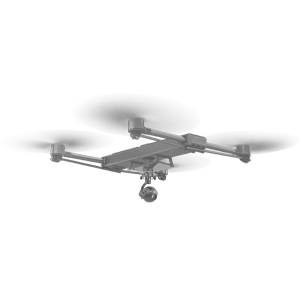
One of the most notable modern MAVs is our own Draganflyer X6. The Draganflyer X6 is a fully autonomous UAV, with sophisticated barometric, GPS, and imaging sensors. It can also be operated by remote control – giving the pilot maximum flexibility and control over the flight plan. It also has the unique ability of folding up to a very small form factor – making it easy to transport, launch and fly by one individual. It is also very quiet, and almost maintenance free. You can learn more about the Draganflyer X6 by visiting it’s product page.
AeroVironment has developed a relatively small UAV, designed to be used by millitary forces for surveillance. The Pointer was a portable UAV, which could be transported in a large vehicle and launched by a crew of only a few people. The Pointer was successful, but the millitary wanted a smaller unit, so AeroVironment designed a smaller version. In 1999, the US army began using very small airplane style UAVs, including the RQ-11 Raven. The Raven is a relatively small UAV, with a wingspan of only 1.34 meters. Developed by AeroVironment, the Raven has become the standard MAV used by the US army, marines, and several other nations. The Raven is small enough to be assembled and launched by one person, and has an endurance of 90 minutes using rechargeable batteries.
Another notable MAV was the Desert Hawk, developed by Lockheed Martin. It is one of the smallest MAVs used the the US millitary, with a wingspan of only 52 inches and weighing 7 lbs. It has an endurance of approximately one hour, and is usually launched using a bungee cord.
Perhaps one of the first true MAVs, as envisioned by DARPA was the AeroVironment Black Widow. With a wingspan of only 6 inches, it certainly would have fit the original specification. The Black Widow is battery powered, and can fly for up to 20 minutes. It carries a very small color video camera, which can provide a resolution of 510 by 492 pixels. This picture gives you an idea of the Black Widow’s scale, it’s shown here beside a standard pencil.
One of the most exotic MAV concepts was the Mesiocopter, designed by Stanford University. It was only one centimeter in diameter, and would be controlled by extremely small electronic circuits. Computer simulations revealed that at extremely small scales, air behaves as an extremely viscous fluid, influencing the propeller design to look much like a conventional house fan, rather than an airplane propeller.
-
Bookmark This Post: These icons link to social bookmarking sites where readers can share and discover new web pages.
  • Facebook
  • Digg
  • Technorati
  • Fark
  • del.icio.us
  • Google
  • Live
  • StumbleUpon

This article is copyright protected.  Written permission by Draganfly Innovation Inc. must be granted to use anything from Draganfly.com

Is Your Company or Organization Technically Fit?

Is your company or organization technically fit? What if you were to look at your business and see what new technologies and equipment you have acquired over the years how much of it is just sitting there and how much of it is used? Many business and public sector organizations acquire new technologies and equipment to assist in improving production or other sectors of their business. Some of the technologies greatly improve the way the business functions. In other cases, while the capability for the newly acquired technology to improve the business is there, for one reason or another it is simply not used. If the latter is the case, it may be due to the company being “technologically unfit” in the use of that equipment or technology.

Much like being physically unfit, being “technologically unfit” may be the result of a combination of several factors including; inadequate training, an inadequate number trained personnel or inadequate use. With some technology the old adage of “use it or lose it” is a very appropriate saying. In situations where time is of the essence, it is not a time to learn how to use the technology or to make critical errors with it due to lack of experience.

Let’s look at the factors for being “technologically unfit”.

Inadequate training. This may be the result of lack of actual instruction or being unable to devote the necessary time to practice with the technology to acquire competence in its use. If sufficient time is not allotted for personnel to gain the skills to competently use a technology, if improperly used it can become a liability.

Inadequate number of trained personnel. Often it is practise for a company or organization to only train one or two personnel in the use of a technology. This may be fine if the personnel assigned this task are going to be able to cover for one another, but what happens when those personnel are unavailable due to other job commitments, sickness, vacation or if they are transferred or quit. If there is nobody trained with the technology to replace these personnel, then it is of little value.

Inadequate use. Inadequate use can occur from the lack of opportunity or situations for use or due to the lack of adequately trained personnel. If this is the case, it is important to continue utilizing the technology in regular practice or scenario type of training to avoid losing the acquired skill necessary to utilize the technology when needed.

So use it or lose it, the choice is yours. However to use it you need to be prepared to give sufficient personnel adequate time to train to become proficient. Otherwise you may just have a lot of technology just sitting there doing nothing for you.

Bookmark This Post: These icons link to social bookmarking sites where readers can share and discover new web pages.
  • Facebook
  • Digg
  • Technorati
  • Fark
  • del.icio.us
  • Google
  • Live
  • StumbleUpon

This article is copyright protected.  Written permission by Draganfly Innovation Inc. must be granted to use anything from Draganfly.com

An Introduction to Unmanned Aerial Vehicles (UAVs)

What Is a UAV

The term UAV is an abbreviation of Unmanned Aerial vehicle, meaning aerial vehicles which operate without a human pilot. UAVs are commonly used in both the military and police forces in situations where the risk of sending a human piloted aircraft is unacceptable, or the situation makes using a manned aircraft impractical.

One of the predecessors of today’s fully autonomous UAVs were the “aerial torpedoes”, designed and built during World War One. These were primitive UAVs, relying on mechanical gyroscopes to maintain straight and level flight, and flying until they ran out of fuel. They would then fall from the sky and deliver and explosive payload.

More advanced UAVs used radio technology for guidance, allowing them to fly missions and return. They were constantly controlled by a human pilot, and were not capable of flying themselves. This made them much like todays RC model airplanes which many people fly as a hobby. It is interesting to note that the government considers all aircraft UAVs, if they are unmanned and used by a government or business.

After the invention of the integrated circuit, engineers were able to build sophisticated UAVs, using electronic autopilots. It was at this stage of development that UAVs became widely used in military applications. UAVs could be deployed, fly themselves to a target location, and either attack the location with weapons, or survey it with cameras and other sensor equipment.

Modern UAVs are controlled with both autopilots, and human controllers in ground stations. This allows them to fly long, uneventfully flights under their own control, and fly under the command of a human pilot during complicated phases of the mission.

What Are UAVs Used For?

Since their creation, UAVs have found many uses in police, military, and in some cases, civil applications. Currently, UAVs are most often used for the following tasks:

  • Aerial Reconnaissance – UAVs are often used to get aerial video of a remote location, especially where there would be unacceptable risk to the pilot of a manned aircraft. UAVs can be equipped with high resolution still, video, and even infrared cameras. The information obtained by the UAV can be streamed back to the control center in real time.
  • Scientific Research – In many cases, scientific research necessitates obtaining data from hazardous, or remote locations. A good example is hurricane research, which often involves sending a large manned aircraft into the center of the storm to obtain meteorological data. A UAV can be used to obtain this data, with no risk to a human pilot.
  • Logistics and Transportation – UAVs can be used to carry and deliver a variety of payloads. Helicopter type UAVs are well suited to this purpose, because payloads can be suspended from the bottom of the airframe, with little aerodynamic penalty.

Types Of UAVs

There are many different types of UAVs, designed for different purposes. The US air force is one of the most prominent users of UAV technology, and classifies UAVs by dividing them into tiers. To get a general idea of the different types of UAVs used, here is an abbreviated version of the US air force specification:

  • Micro UAVs – small, extremely portable units.
  • Low altitude, long endurance UAVs
  • High altitude, long endurance UAVs employing a conventional design.
  • High altitude, long endurance UAVs using a low observable design.

Some UAVs use a blimp design, and are well suited to carrying large amounts of cargo.
Some of the first UAVs were called “drones” and were not autonomous, because
they required constant control input from a remote human pilot. Computer technology now allows UAVs to make their own decisions, or fly autonomously. Autonomous flight involves the UAV making decisions as it flies.

Generally, autonomous flight consists of the following operations:

  • Interpreting sensor input, and merging the input of multiple sensors
  • Communicating with ground stations, satellites, and other UAVs and aircraft
  • Determining the ideal course to fly for a given mission, based on sensor input.
  • Determining the best maneuvers to perform for a given task
  • In some cases, cooperating with other UAVs to accomplish a common task.

The Swarm Project by MIT is an excellent example of cooperation between UAVs. Autonomy is an area of rapid development, with the ultimate goal of replacing the human pilot entirely.

Conclusion

UAVs represent an area of rapid development in both military and civilian applications. UAVs unique capability of flying dangerous, long, or precision missions give it a unique advantage over conventional aircraft. This article has only briefly introduced UAVs and their applications.

Bookmark This Post: These icons link to social bookmarking sites where readers can share and discover new web pages.
  • Facebook
  • Digg
  • Technorati
  • Fark
  • del.icio.us
  • Google
  • Live
  • StumbleUpon

This article is copyright protected.  Written permission by Draganfly Innovation Inc. must be granted to use anything from Draganfly.com

RC Aerial Photography – What You Need To Know to Get Great Pictures

Introduction

Aerial photography has been used since the first hot air balloons to give a new perspective to the objects and landscapes in our world. With the modernization of both aviation and camera technology, a new type of aerial photography was born. RC aerial photography uses ordinary to advanced RC aircraft to carry a camera payload and obtain aerial pictures. RC aerial photography has evolved into both an exciting hobby, and a thriving business.

RC aerial photography can add a new perspective to images of large objects. by showing the large scale relation between different objects. Many engineering, mapping, and surveying projects depend on a clear understanding of the large scale properties of an area of land, making aerial photography the perfect tool for obtaining this information. Traditionally, aerial pictures were obtained by sending a human photographer on a flight in a full scale aircraft, usually either an airplane or helicopter. This is a time consuming and inconvenient, because aerial photography is affected by rapidly changing weather and lighting conditions.

RC aerial photography is a simple and cost effective solution. You can rapidly deploy and recover an RC aircraft, and get aerial pictures of equal to (and in many cases better) quality than those taken from a full scale aircraft. Conventional aircraft are limited by altitude regulations, so they can fly at a minimum of 500 feet above ground level. RC aircraft are free to maneuver at any altitude, giving you the freedom to decide which altitude is best for your aerial photographs.

Not only is RC aerial photography a valid business, it’s also a great hobby. What better way to get aerial pictures of your house, or pictures of your street than with your own RC aircraft?

This article will introduce you to RC aerial photography, show you how to get great aerial pictures, and demonstrate some of the many applications of available technology.

The Basics Explained: Light and Angle

Light is one of the primary factors affecting any aerial photo. Unlike indoor photography where several sources of light are available, RC aerial photography depends entirely on the light provided by the Sun. Use sunlight to your advantage by following these guidelines:

Ground based photography is best done in the morning or evening, because the of the favorable lighting and because shadows are hidden behind the subject. Aerial photography exposes these shadows, so try to take your aerial pictures when the Sun is highest in the sky. This is usually between 10:00 AM and 2:00 PM, but will vary from season to season. Taking aerial photos when the Sun is high will minimize the shadows that appear in your aerial pictures, increasing clarity and reducing “visual clutter”.

There are three main angles or styles from which aerial photos are taken. Each produces a different visual effect, and is used for different applications. They are listed as follows:

  1. Vertical – Vertical images are taken with the camera pointing straight down. This is a great angle for surveying, because it gives the photo a scale that you can use to measure the distance between objects. You can calculate the scale of an aerial photo by dividing the focal length of the lens by the altitude of the RC aircraft. For example, an aerial picture taken from a camera with a focal length of 1 inch at an altitude of 50 feet (600 inches) would have a sca1e of 1/600. This means that one inch measured on the image corresponds to 600 inches on the photo. This calculation will work with any units (kilometers, meters, yards etc.) as long as both the focal length of the camera and the height above ground are expressed in the same units. Because the camera refocuses to keep the image sharp, this method will provide only a rough estimate of the scale factor of the image. Fortunately, software is available to calculate and measure distances on aerial photos precisely.
  2. Low Oblique – Low oblique photos are taken from an angle of 40 degrees from vertical. They provide a a large view of the ground, but don’t show the horizon.
  3. High Oblique – High oblique photos are taken at least 70 degrees from vertical, and include the horizon. High Oblique photos will provide a very large overview of an area, and can show varying amounts of sky in the image depending on the angle from the ground.

Atmospheric Effects

There are several atmospheric affects which influence the look of your aerial photos:

  1. Haze – Haze is caused by particles and water drops suspended in the air. Haze severely limits the contrast of your pictures, because the light emitted from them had to travel through hundreds of feet of haze before reaching the camera. Haze is most common in metropolitan areas, where there is significant pollution, and during the summer months. Even if atmospheric conditions aren’t perfect, you can minimize their effects on your pictures by shooting with the sun at the back of the camera. This avoids showing haze or smoke in the atmosphere.
  2. Clouds – Clouds can also hinder RC aerial photography, by diffusing light and casting large shadows on the ground. In general cumulus clouds (large, low clouds) are the most obscuring, but even thin cirrus (high and wisp like) clouds can cause a loss of lighting. Try to take aerial pictures on days with a minimum amount of cloud cover.
  3. Smog – Smog has a similar effect as haze, reducing the clarity of your aerial pictures. Smog is caused by excessive air pollution, and is most common in large cities.

Effects Caused By Motion

Cameras work by letting light hit a photosensitive material for a set amount of time. If the camera or subject are moving relative to one another, then image blurring will occur during the exposure time. By reducing the exposure time (increasing the shutter speed) you can minimize blurring in your aerial photos. You can also minimize image blurring by matching speed and direction with the target.

Planning The Flight

The most important factor that you need to consider when planning an RC aerial photography flight is the weather. As previously discussed, cloud cover will lower available light and reduce the contrast of the aerial pictures. Wind also has an adverse effect on RC aerial photography – creating unwanted motion between the camera and the subject being photographed. Also, RC become difficult to control in high wind conditions, increasing the chances of an accident.

An ideal day for RC aerial photography would be windless, completely clear of clouds, and free of any atmospheric interference (smog, haze etc.) Because this is rarely the case, you will have to listen to weather reports and use your own judgment to determine the best days to fly. There are several excellent sources of weather information available, including radio reports, television, and the internet. You can find weather information and forecasts at the Weather Network and (for Canadian locations) at Navcanada. By clicking on the METAR/TAF button on the Navcanada forecasts and observations page, you can browse frequently updated weather data, used every day by pilots of full scale aircraft. Unless you are familiar with METAR/TAF abbreviations, we suggest that you select plain English forecasts and reports. The METAR is a weather report taken at a current time for a certain location, and the TAF is a forecast predicting the at the location.

Weather reports outside North America can be found on BBC Weather.

Conclusion

RC aerial photography can provide a new perspective on everyday objects and places. New platforms, such as the Tango aircraft (for long range applications) and the Draganflyer X6 open new possibilities for this exciting business and hobby. A full exploration of RC aerial photography is beyond the scope of this article, we suggest reading some of the excellent books on the subject available.

Bookmark This Post: These icons link to social bookmarking sites where readers can share and discover new web pages.
  • Facebook
  • Digg
  • Technorati
  • Fark
  • del.icio.us
  • Google
  • Live
  • StumbleUpon

This article is copyright protected.  Written permission by Draganfly Innovation Inc. must be granted to use anything from Draganfly.com

Draganfly Innovations Inc.

Close