The Development of MAVs
MAVs have been in development since the early 1990’s, and only recently became economically and technologically viable. This article will introduce you to the development and evolution of micro UAVs and show you some examples of both practical MAVs used by government organizations and concepts designed for more exotic uses.
MAVs were first conceived of during the 1980’s, when the first full scale UAVs were produced. However, electronics and propulsion technology was not yet advanced enough to allow the creation of fully autonomous UAVs, let alone the sophisticated MAVs envisioned by engineers.
It wasn’t until the early 1990’s that technology had advanced enough to make autonomous MAVs feasible, and it would take several years of research and development before they entered widespread usage. One of the main contributors to MAV research was DARPA (Defense Advanced Research Projects Agency), an agency of the United States department of defense. In 1992, DARPA hosted a workshop discussing the potential of MAVs (called “micro drones” at the time). The idea was met with enthusiasm, and paved the way for the MAV research and development that was to take place shortly after.
After a series of papers demonstrating the feasibility of MAVs, DARPA began a 35 million dollar project to develop and test a UAV, only 6 inches in it’s largest dimension. The MAV would need to carry a night / day imaging device, and operate for at least 2 hours. This study was terminated in 2001, and DARPA’s interest shifted to commercial vendors capable of producing MAVs to the initial design specification.
A large variety of corporations and universities designed MAV airframes which met the original requirements, but they still lacked a sufficiently small propulsion system. Electric motors were available, but battery technology was not yet advanced enough to power small electric motors sufficiently. Because of this, chemical engines and motors were investigated.
One of the most interesting chemical engine designs was a micro jet, designed to run on natural gas. The jet featured a small turbine, running within a 2 cm diameter silicon case. Unfortunately, such an engine would run at an extremely high temperature, necessitating silicon carbide construction.
These initially negative results influenced DARPA and other organizations to pursue other, larger UAV designs.
Modern and Concept MAV’s
Most modern MAVs are designed to be smaller than conventional UAVs, but not to the extent in visioned by organizations like DARPA. Most UAVs used by the military and government organizations are hand launched units, able to be transported and deployed by one individual. Smaller concept MAVs are still under active development, but for now, only larger MAVs are frequently used. This section lists both MAVs currently used by the police and millitary, and some more exotic concept MAVs still under development.
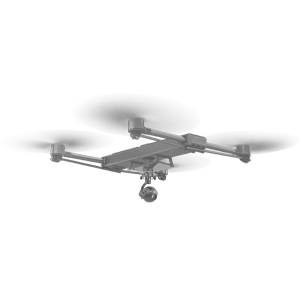
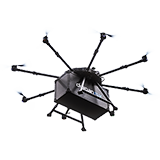
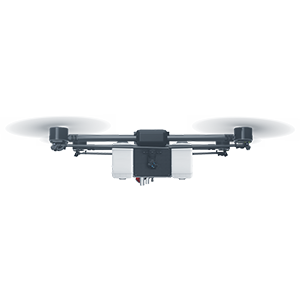
One of the most notable modern MAVs is our own Draganflyer X6. The Draganflyer X6 is a fully autonomous UAV, with sophisticated barometric, GPS, and imaging sensors. It can also be operated by remote control – giving the pilot maximum flexibility and control over the flight plan. It also has the unique ability of folding up to a very small form factor - making it easy to transport, launch and fly by one individual. It is also very quiet, and almost maintenance free. You can learn more about the Draganflyer X6 by visiting it’s product page.

AeroVironment has developed a relatively small UAV, designed to be used by millitary forces for surveillance. The Pointer was a portable UAV, which could be transported in a large vehicle and launched by a crew of only a few people. The Pointer was successful, but the millitary wanted a smaller unit, so AeroVironment designed a smaller version. In 1999, the US army began using very small airplane style UAVs, including the RQ-11 Raven. The Raven is a relatively small UAV, with a wingspan of only 1.34 meters. Developed by AeroVironment, the Raven has become the standard MAV used by the US army, marines, and several other nations. The Raven is small enough to be assembled and launched by one person, and has an endurance of 90 minutes using rechargeable batteries.

Another notable MAV was the Desert Hawk, developed by Lockheed Martin. It is one of the smallest MAVs used the the US millitary, with a wingspan of only 52 inches and weighing 7 lbs. It has an endurance of approximately one hour, and is usually launched using a bungee cord.
Perhaps one of the first true MAVs, as envisioned by DARPA was the AeroVironment Black Widow. With a wingspan of only 6 inches, it certainly would have fit the original specification. The Black Widow is battery powered, and can fly for up to 20 minutes. It carries a very small color video camera, which can provide a resolution of 510 by 492 pixels. This picture gives you an idea of the Black Widow’s scale, it’s shown here beside a standard pencil.
One of the most exotic MAV concepts was the Mesiocopter, designed by Stanford University. It was only one centimeter in diameter, and would be controlled by extremely small electronic circuits. Computer simulations revealed that at extremely small scales, air behaves as an extremely viscous fluid, influencing the propeller design to look much like a conventional house fan, rather than an airplane propeller.
-
Bookmark This Post:
These icons link to social bookmarking sites where readers can share and discover new web pages.